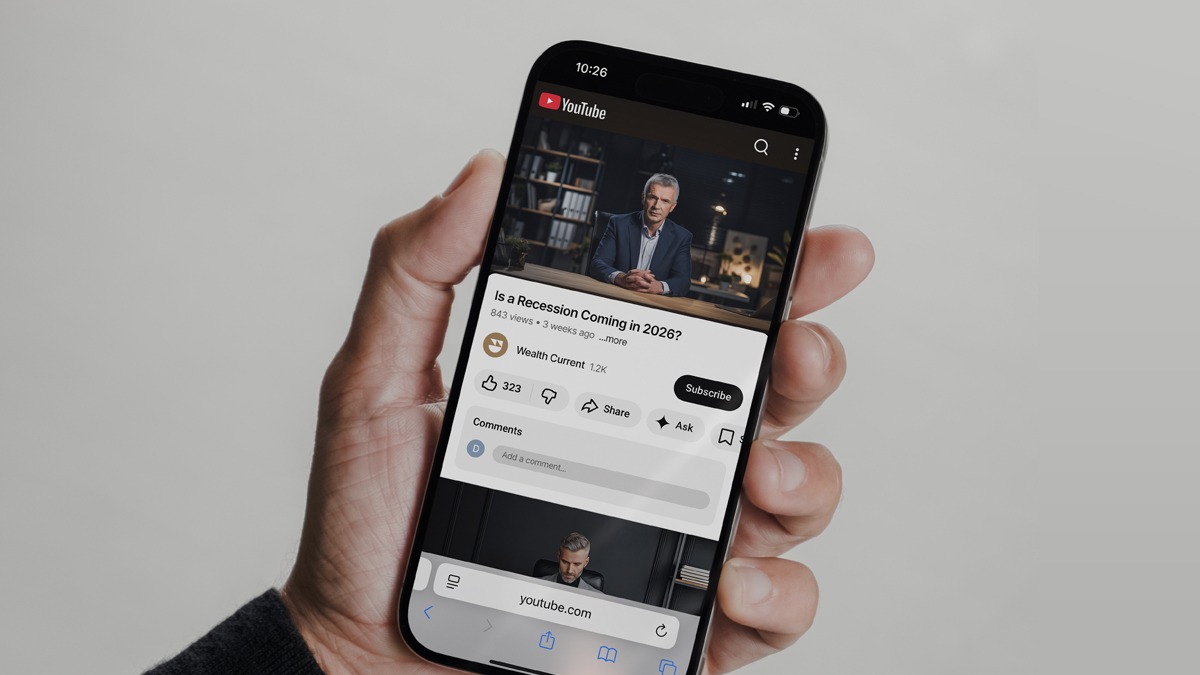
In our previous article, we took a look at how some financial advisors are betting on content marketing platforms to scale their brands and reach their clients and prospects. While this growing trend of multi-channel marketing continues to gain traction, one of the more intriguing platforms remains the untapped market of video — specifically YouTube.
A Global Media Juggernaut
A quiet revolution has been under way in how people consume information, news, entertainment — and increasingly, financial education. The video-centric platform YouTube has grown from a hobbyist video site to a global media juggernaut. As of mid-2025, YouTube boasts roughly 2.70 billion monthly active users globally. The platform now reaches 85% of U.S. adults, according to Pew Research, and 32% of U.S. adults say they regularly consume news and information on YouTube and it’s a share that has grown steadily over the past five years.
What’s more, YouTube has transcended the “desktop or phone only” era. In the first half of 2025, the platform recorded 45.1 billion total viewing hours in the U.S., with “TV-screen” viewing (via smart TVs or connected devices) now accounting for about 36% of that time. In other words, more and more viewers treat YouTube like television itself and as a replacement for traditional broadcast or cable TV. Indeed, April 2025 marked the third consecutive month in which YouTube topped all other media companies in the U.S. for share of “TV-equivalent” viewing time.
For consumers, the appeal is clear. Among all types of content on YouTube, “educational and how-to” videos rank consistently near the top. In fact, this type of content outpaces many typical entertainment verticals — underscoring how YouTube has evolved from a video-sharing site into a go-to destination for learning, problem-solving, and personal development. For many users, especially those seeking financial knowledge or guidance, YouTube is increasingly a first stop.
A Golden Opportunity for Financial Advisors
This migration toward video as an information source is reshaping how financial advice is discovered and consumed, but it also exposes the operational and strategic challenges facing an industry long accustomed to written commentary, seminars, and in-person meetings.
For financial advisors and wealth-management firms, this shift toward video as an information source is a golden opportunity. The platform gives them direct access to their clients and prospects in a medium that supports depth, authenticity, and trust-building before any face-to-face meeting ever happens.
Consider the following scenario.
You have a prospect you’ve never spoken to at length, but have a mutual friend or client. He’s a mid-50s manufacturing business owner, married with three children, one of whom works in the company and is expected to take over.
One potential solution to making direct contact would be to send a simple re-introduction that also contains an email link to a relevant YouTube video you’ve created titled “Succession Planning & Preparing the Next Generation” or “Retirement Planning When Your Net Worth Is Tied Up in the Business.”
This type of evergreen content works like a swiss army knife. It immediately captures the prospect’s attention by speaking to their exact circumstances, it begins building that ever so important trust and familiarity, it can be used to attract other potential clients, helps your overall SEO presence if you also post it on your website, and provides valuable brand exposure that can be discovered infinitely.
Why Many Financial Advisors Don’t Yet Embrace YouTube and Why That’s Understandable
Video adoption is rising, though not evenly. Hearsay Systems, a compliance-driven digital communications platform for financial institutions, has reported a sharp increase in advisor-generated video in recent years, with video posts rising nearly 300% between 2019 and 2023. The surge shows that firms are ramping up video capability, but it does not necessarily mean advisors are turning to YouTube in large numbers.
Investor demand, however, is there. Research from Advisor360° found that nearly half of affluent investors say they would engage with an advisor they discover on YouTube. Yet the platform ranks low as a direct source of new clients for advisors: Broadridge Financial Solutions has consistently placed YouTube near the bottom of its social-media conversion surveys, capturing only a small share of leads compared with LinkedIn or Facebook.
For advisors, this disconnect between investor interest and advisor participation reflects a simple truth: YouTube is not a low-effort channel and like most marketing and messaging efforts, it’s a marathon not a sprint.
If the opportunity seems clear, why haven’t more financial advisors embraced it already? In practice, several common obstacles stand in the way:
Bandwidth and time commitment
Producing quality video content. From planning topics, writing scripts, to filming and editing requires time and attention. For many advisors juggling client work, compliance requirements, market updates, and practice management, dedicating consistent time to video creation can feel like a stretch.
Compliance and regulatory risk
Financial advice is heavily regulated. Advisors may worry about inadvertently running afoul of compliance rules, especially when discussing market developments, investments, or giving financial advice in a publicly available video.
A senior executive at a Midwestern RIA recently noted that “filming a five-minute market update takes 30 minutes; getting it through compliance takes three days.” It is a familiar refrain in an industry where regulatory oversight shapes nearly every communication.
Comfort zone and expertise
Not every advisor is a seasoned presenter. Some may feel uneasy speaking on camera, crafting messages that are both professional and approachable, or editing video for publication. They may also doubt whether their content will “get traction.”
Consistency and sustainability
A one-off video rarely builds momentum. To use YouTube effectively often requires a sustained commitment to producing content on a regular cadence — which can feel daunting when added to an already busy advisory practice.
But in our view and experience serving independent financial advisors, these are not insurmountable barriers. Rather, they are real constraints that can be strategically managed and the upside often justifies the effort.
Partnering with a specialized agency, one that understands both video production and the financial advisory space can mitigate most of these challenges. An experienced partner can manage logistics (shooting, editing, YouTube channel management), ensure compliance safeguards, and help shape a content strategy aligned with your firm’s voice and regulatory comfort level. That leaves advisors free to focus on what they do best: managing clients’ portfolios and giving personalized advice.
Tips for Launching a Successful YouTube Strategy
If you’re ready to explore video, here are some best practices grounded in what people watching YouTube actually respond to:
Prioritize educational, value-first content
Long-form “how-to,” explainer, market-insight, and educational finance content remains among the highest-performing genres on YouTube. Videos that clearly address common financial questions. Topics like “What is sequence of returns risk?” or “How to build a retirement withdrawal plan” tend to build trust and retain audience attention.
Consistency and cadence matter
Aim for a reliable publishing schedule. Publishing a new video every week to a bi-weekly schedule will provide enough consistency to scale your brand awareness and build trust. Consistency signals seriousness and helps build an audience over time.
Optimal video length and format
Data suggests many YouTube viewers prefer videos in the 5 to 20 minute range, which is a “sweet spot” for engagement without overwhelming viewers. For deeper topics, consider breaking into a short series — easier to consume, and keeps viewers coming back.
Be genuine, transparent, and compliant
Authenticity builds trust. Speak plainly and try to avoid heavy jargon when possible. When discussing investment concepts or advice, maintain clarity around disclaimers, risk, and limitations. Work with your compliance/legal team or an agency familiar with advisor regulations before publishing.
Leverage a trusted partner when helpful
If you don’t have in-house video production capabilities, engaging a specialist agency can reduce friction, help maintain consistency, and manage compliance. This allows advisors to stay focused on their core practice activities while building an effective video presence.
Why Advisors Should Take the Leap and Why Now Is the Moment
The media consumption landscape has shifted. For many Americans, especially younger and middle-aged cohorts, video content on YouTube is no longer just a supplement to traditional media — it is one of the primary sources of news, education, and entertainment. The sheer reach (billions of monthly users globally), the shift toward TV-screen viewing, and the strong appetite for educational content all point toward a future in which video — not print, not webinars, not static websites — becomes a cornerstone of client engagement and marketing.
For financial advisors, YouTube offers a unique mix of scale, personalization, and trust-building that’s hard to replicate through other channels. With thoughtful content, consistency, compliance awareness, and the support of a specialized agency partner, establishing a YouTube can become one of the most powerful growth engines in a modern advisory business.
If you’re interested in learning more about how Aurmis can support your efforts to reach a broader audience, contact us today to schedule an introduction.